EV towing in South Los Angeles
Yes, an electric car can be towed, but its maker decides how. Some EVs must not be towed with their drive wheels on the ground, because the motor can generate electricity as the wheels turn. 1st Resort Towing Service offers electric vehicle towing in South Los Angeles. When you call or text (310) 598-1619, have the make, model and year ready, and say whether the car powers on. Call to check current availability.
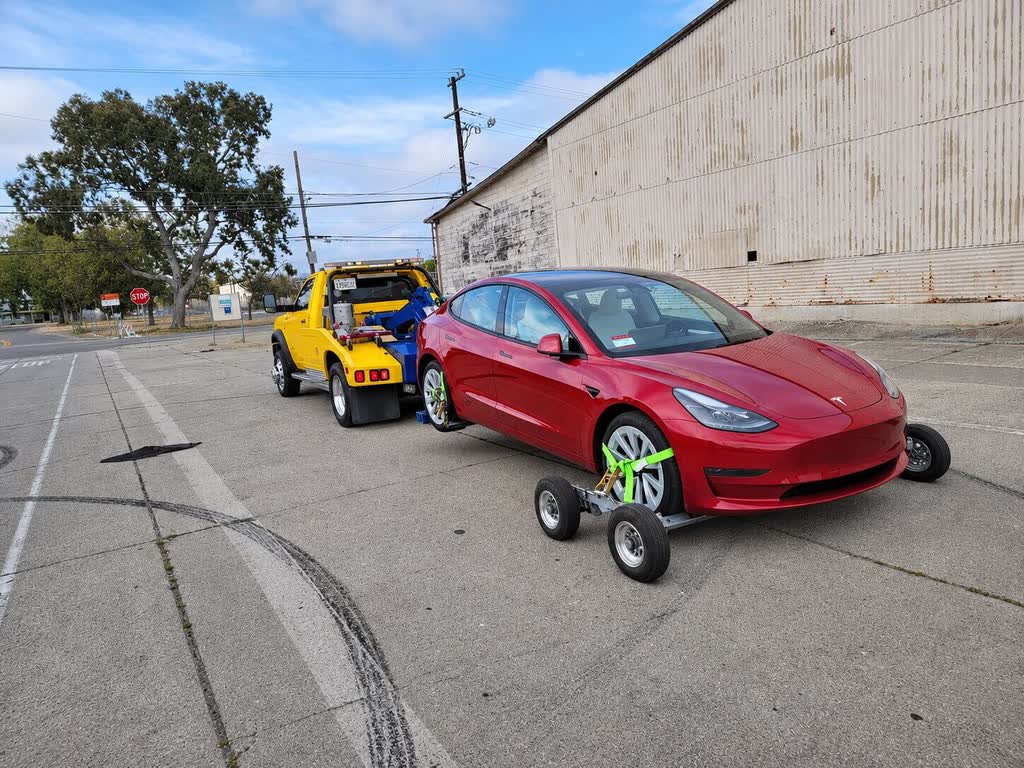
Start with the owner’s manual
Search the manual, or the maker’s app, for “towing” or “transporting”. The rules change between brands and sometimes between models of the same brand. Two examples:
- A Kia electric-vehicle manual recommends wheel dollies or a flatbed. It warns that if the driven wheels are on the ground during a tow, “the vehicle motor may generate electricity and the motor components may be damaged or a fire may occur.”
- A Hyundai owner’s manual also recommends wheel dollies or a flatbed and says not to use sling-type tow equipment. For the two-wheel-drive version it accepts the front wheels on the ground, but warns that towing with the rear wheels down may damage the vehicle.
So “flatbed only” is true for some cars and not for others. The manual for your exact car is the one that counts. 1st Resort has no affiliation with any vehicle maker.
We run flatbed and wheel-lift tow trucks. The general difference between the two is explained on the flatbed towing page.
Rolling the car onto the truck
Manuals set tight limits on letting the car roll on its own wheels, even for loading. The Kia EV manual allows only a very short move, within 32 feet at 3 mph, with the car in Neutral and the parking brake released, when it’s being loaded or needs to be repositioned. The Hyundai manual sets almost the same limit (33 feet at 3 mph or less). If the gear shift and parking brake can’t be operated, the Kia manual says to move it with the rear wheels off the ground.
Your manual may give the loading setting its own name and steps. Look it up before the truck arrives if you can.
Which battery is the problem?
An electric car has two batteries, and each one fails differently.
- The small 12-volt battery runs the screens, locks and computers. When it’s flat, the car can look completely dead even with a charged main battery. EV manuals include their own 12-volt jump-start steps, and we can jump-start an EV’s 12-volt battery.
- The large high-voltage battery drives the car. If the car powers up but shows zero range, the car needs charging, which means moving it to a charger.
- If a collision damaged the area around the battery or the wheels, tell us. See accident towing for the steps at the scene.
Have this ready
- Make, model and year
- Zero range, or no power at all?
- Can it be shifted to Neutral, and does the parking brake release?
- Any warning messages on the screen
- Where it should go: a service center, a dealer, a charger or home
For a gas or hybrid car with an ordinary breakdown, see car, SUV and pickup towing.
EV towing questions
Can an electric car be towed?
Yes, by following the manufacturer’s towing instructions. The Kia and Hyundai manuals quoted above both recommend wheel dollies or a flatbed.
What is tow (transport) mode?
It’s the manual’s procedure for letting the car roll a short way, usually to load it. In the Kia and Hyundai manuals above, that means Neutral with the parking brake released, at 3 mph or less, for no more than about 32 to 33 feet. It doesn’t make the car safe to tow on its own wheels. Your manual shows what your car calls it and how to set it.
Can you tow an EV with the wheels on the ground?
Only if the manual for that model allows it. The Kia EV manual warns against towing with the driven wheels on the ground. Tell us the model when you call, and keep the manual or the maker’s app handy.
Do you tow hybrids and EVs on a flatbed?
We run flatbeds and wheel-lifts. Tell us the make, model and year, and whether it’s all-wheel drive, and we’ll tell you on the call how it will be moved.